
Introduction
The BMC Election 2026 results have sparked widespread discussion across political and civic circles, not just because of the outcome but due to the shift in campaign strategy and voter priorities. The Brihanmumbai Municipal Corporation (BMC), India’s richest civic body, has once again proven that local governance, urban development, and civic infrastructure matter deeply to Mumbai’s voters.
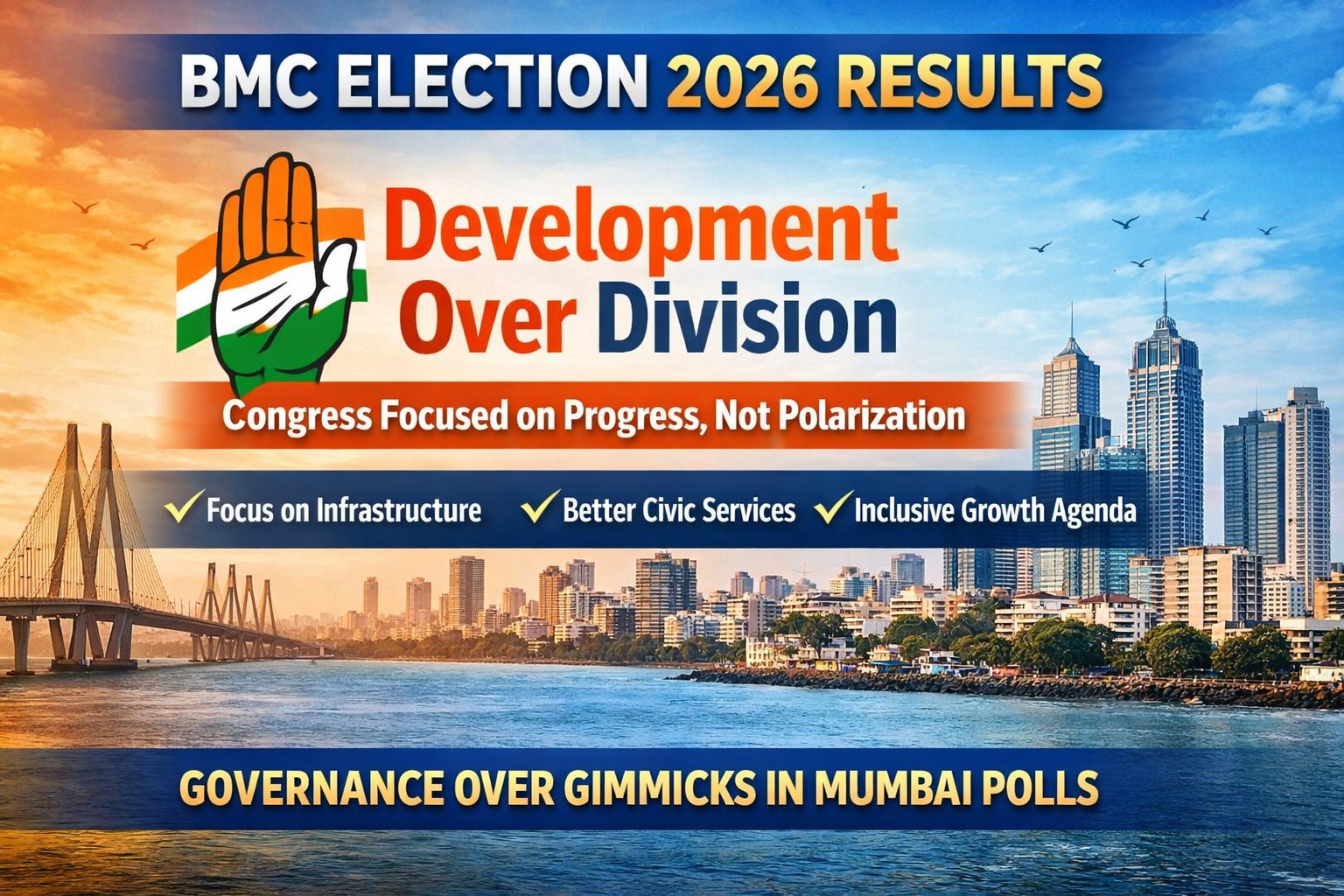
One of the most notable aspects of the BMC Polls 2026 was the Congress party’s clear focus on development-driven governance, steering away from divisive political narratives and instead highlighting issues such as public infrastructure, housing, healthcare, and transparency. This approach resonated strongly with urban voters who demanded practical solutions over political rhetoric.
Why the BMC Election Matters in 2026
The BMC controls a budget larger than several Indian states, making it a power centre of urban governance. The 2026 election was not merely a municipal contest—it was a referendum on urban leadership, accountability, and service delivery.
Key reasons the BMC Election 2026 gained national attention:
- Mumbai’s growing infrastructure and housing challenges
- Rising cost of living and civic service expectations
- Demand for corruption-free governance
- Youth and middle-class voter participation
- Impact on Maharashtra’s broader political landscape
Congress’ Development-First Strategy in BMC Polls 2026
Unlike traditional high-decibel political campaigns, Congress adopted a measured, policy-centric approach during the BMC elections. The party positioned itself as a civic reformer rather than a political agitator.
Core Themes of Congress’ Campaign
- Urban infrastructure modernization
- Affordable housing and slum redevelopment
- Healthcare accessibility and municipal hospitals
- Education reforms in civic schools
- Transparency in municipal contracts
- Environmental sustainability and coastal protection
This development-focused agenda stood in contrast to campaigns rooted in identity politics or ideological polarization.
Voter Response: Development Over Divisive Politics
Mumbai’s electorate, particularly urban professionals, women voters, and young citizens, responded positively to issue-based campaigning. The BMC Election 2026 results indicated a growing maturity among voters who prioritized:
- Reliable water supply and sanitation
- Road quality and traffic management
- Flood mitigation and disaster preparedness
- Digital governance and civic accountability
The Congress narrative aligned closely with these expectations, reinforcing the idea that municipal elections are about governance, not grandstanding.
Shift in Urban Political Trends
The BMC polls highlighted a larger national trend—urban voters are increasingly separating local governance from state and national politics. The Congress campaign benefited from this shift by avoiding ideological battles and focusing on day-to-day civic life.
Political analysts noted that voters rewarded:
- Clear manifestos
- Local leadership credibility
- Practical policy proposals
- Data-driven governance promises
Challenges Faced by Congress in BMC Election 2026
Despite its development-centric approach, Congress faced challenges such as:
- Strong regional party influence
- High expectations from urban voters
- Scrutiny over past governance records
- The need for sustained grassroots presence
However, the party’s messaging helped rebuild trust and positioned Congress as a serious civic governance contender rather than just an opposition force.
What the BMC Election 2026 Result Signals for the Future
The outcome sends a clear message to all political parties:
Urban India wants governance, not gimmicks.
Key takeaways include:
- Municipal elections are increasingly performance-driven
- Development narratives outperform polarizing agendas
- Civic issues can shape political credibility
- Accountability and transparency matter more than slogans
For Congress, the BMC result serves as a blueprint for future urban campaigns across metropolitan cities.
Impact on Mumbai’s Civic Governance
Post-election expectations are high. Citizens anticipate:
- Faster project execution
- Better budget utilization
- Reduced corruption
- Inclusive urban planning
The BMC Election 2026 has set a benchmark for civic responsibility, making governance outcomes as important as election promises.
Conclusion
The BMC Election 2026 results underline a decisive shift in voter mindset. Congress’ emphasis on development, inclusivity, and governance proved that municipal elections demand a different political language—one rooted in solutions, not division.
As Mumbai moves forward, the election stands as a reminder that urban democracy thrives when voters demand performance over politics.
Frequently Asked Questions (FAQs) – BMC Election 2026 Result
1. What is the BMC Election 2026?
The BMC Election 2026 refers to the civic body elections held to elect representatives of the Brihanmumbai Municipal Corporation, which governs Mumbai’s municipal administration, infrastructure, and public services.
2. Why is the BMC Election considered important?
The BMC is India’s richest municipal corporation with a massive annual budget. Decisions taken by the BMC directly impact Mumbai’s infrastructure, healthcare, education, roads, sanitation, and disaster management.
3. What was the key highlight of the BMC Election 2026 result?
One of the major highlights was the increased focus on development-oriented campaigning, particularly by the Congress party, which emphasized governance, infrastructure, and civic services over divisive political narratives.
4. What strategy did Congress follow in the BMC Polls 2026?
Congress adopted a development-first approach, focusing on issues such as urban infrastructure, affordable housing, healthcare improvements, education, transparency, and environmental sustainability.
5. How did voters respond to development-focused campaigning?
Urban voters responded positively to issue-based campaigning. Many voters prioritized practical civic solutions such as better roads, flood control, public transport, and digital governance over ideological debates.
6. Did the BMC Election 2026 reflect a change in voter mindset?
Yes, the election indicated a shift where voters increasingly separated municipal governance from state and national politics, emphasizing local development and administrative efficiency.
7. What role did urban issues play in the BMC Polls 2026?
Urban challenges like traffic congestion, monsoon flooding, housing shortages, healthcare access, and cleanliness were central to voter decision-making during the election.
8. How does the BMC Election 2026 impact Mumbai’s future governance?
The results have raised expectations for improved civic services, transparent governance, faster project execution, and responsible use of public funds in Mumbai.
9. What lessons can political parties learn from the BMC Election 2026?
The election shows that performance-based governance, clear policy agendas, and civic accountability are becoming more influential than polarizing narratives in urban elections.
10. Can the BMC Election 2026 influence future urban elections in India?
Yes, the BMC Election 2026 may serve as a model for future municipal elections in major cities, highlighting the importance of development-focused and voter-centric governance strategies.
11. Where can citizens get official updates on BMC election results?
Citizens can check official updates through the State Election Commission, authorized news portals, and official BMC communication channels.
12. Why is development-focused politics gaining importance in municipal elections?
Municipal elections directly affect daily life. Voters increasingly expect measurable improvements in services, making development-based politics more relevant at the civic level.